
Blackjack Payout Calculator
A natural blackjack pays more than a regular win.
The catch is that not every table pays the same.
Enter your bet below, pick the payout your table offers, and see exactly how much you win on a blackjack.
3 to 2 Blackjack Payout Calculator
The standard payout. Best for the player.
Your $100.00 bet at every payout
Same hand, same bet. The payout ratio is the only thing that changes.
| Payout | You win | Vs 3 to 2 |
|---|---|---|
| 3 to 2 | $150.00 | Baseline |
| 6 to 5 | $120.00 | -$30.00 |
| 7 to 5 | $140.00 | -$10.00 |
| 2 to 1 | $200.00 | +$50.00 |
| 1 to 1 | $100.00 | -$50.00 |
How does a blackjack payout work?
A natural blackjack is an Ace plus any 10-value card on your first two cards.
When you hit one, the dealer pays your bet at the table’s blackjack ratio instead of the standard 1 to 1 you get on a regular win.
At a 3 to 2 table, you win 1.5 times your bet.
At a 6 to 5 table, you only win 1.2 times.
Every other win at the table still pays 1 to 1.
The blackjack ratio only kicks in on a natural blackjack.
Why the difference between a 3:2 vs 6:5 payout matters?
The gap looks small on a single hand.
But in reality it isn’t.
On a $100 bet, 3 to 2 wins $150.
On the same hand at a 6 to 5 table, you win only $120.
That’s $30 you leave on the table every time you hit a blackjack.
Considering that in general a natural blackjack comes up roughly once every 21 hands, that’s a huge difference.
We estimate that over a 4-hour session at 80 hands per hour, that’s about 15 blackjacks.
At a $100 bet on a 3 to 2 table, those 15 blackjacks pay you $2,250.
On a 6 to 5 table, the same 15 blackjacks pay only $1,800.
That’s $450 the casino keeps just from the payout ratio.
The truth is, that $450 gap is for the same hands, the same time, and the same drinks.
The only difference is the number printed on the felt.
Over a year of casual play, the gap compounds into thousands of dollars.
We broke down the math in detail in the upcoming 6 to 5 blackjack post.
How do you spot a 6 to 5 blackjack table?
Look at the felt before you sit down.
Every table prints the blackjack payout right next to the dealer.
It’s usually a small line that reads “Blackjack pays 3 to 2” or “Blackjack pays 6 to 5.”
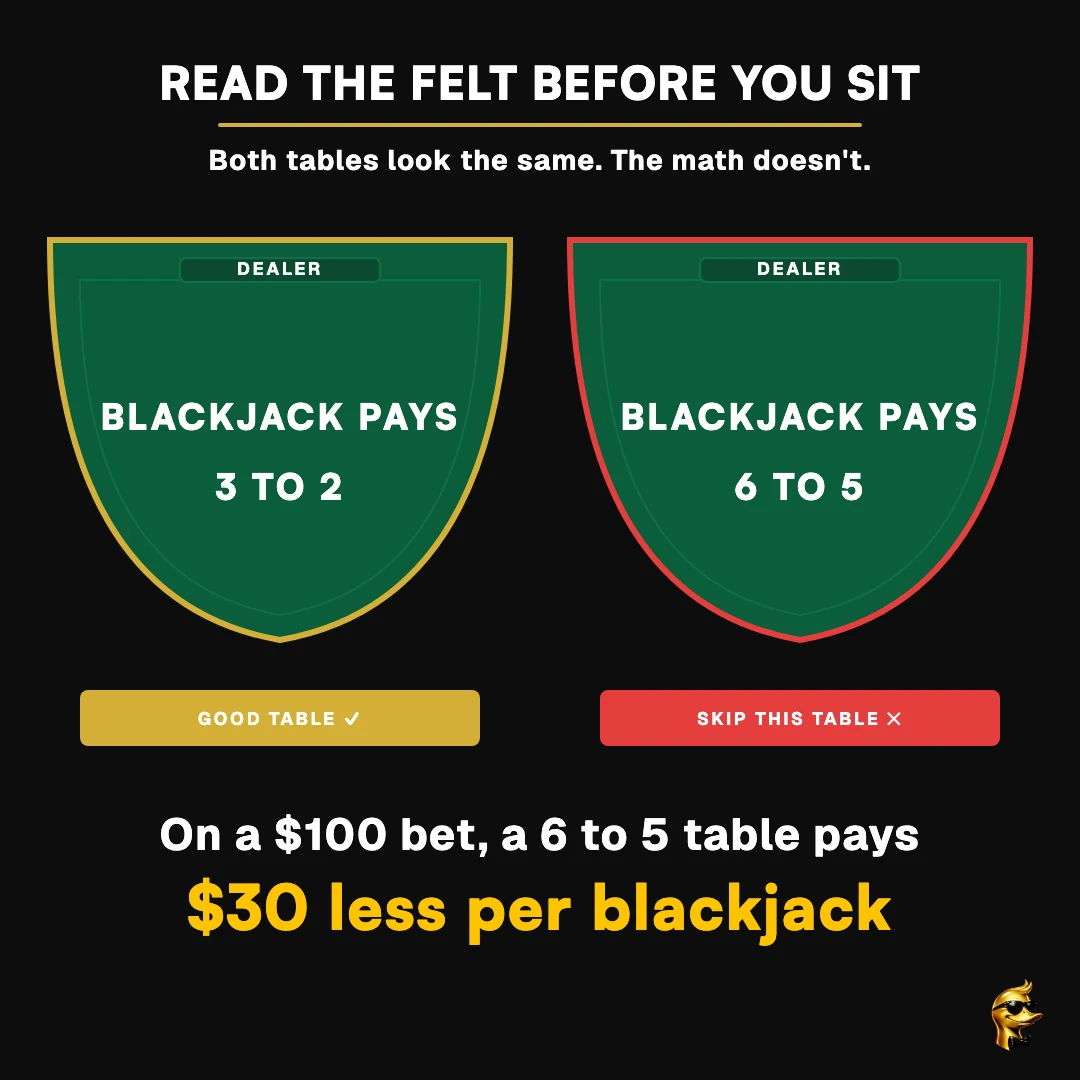
If the felt says 6 to 5, walk to another table.
Casinos rarely mix the two payouts on the same shift, so a different pit or a different floor usually has a 3 to 2 game running.
The 6 to 5 tables tend to live in the low-limit pit ($5 and $10 minimums) and on the casual casino floor.
The 3 to 2 tables usually start at $15 or $25 minimums.
If your bankroll only supports the low-limit pit, the smarter move is often to drop your bet size and find a 3 to 2 table at a higher minimum.
A $15 bet at 3 to 2 still wins more on a blackjack than a $25 bet at 6 to 5.
Frequently asked questions
What does a blackjack pay?
A natural blackjack pays 3 to 2 at most fair tables, which means a $100 bet wins $150. Some tables pay 6 to 5 instead, which means a $100 bet only wins $120. The payout ratio is set by the casino and printed on the felt at every table.
What is the difference between 3:2 and 6:5 blackjack?
The 3 to 2 table pays $1.50 for every $1 you bet on a natural blackjack. The 6 to 5 table pays $1.20 for every $1. On a $100 bet, that’s a $30 gap on a single blackjack, and the gap compounds across every blackjack you hit in a session.
How do you calculate a blackjack payout?
Multiply your bet by the payout ratio. A 3 to 2 payout is 1.5 times your bet. A 6 to 5 payout is 1.2 times your bet. So a $50 bet wins $75 at 3 to 2 and $60 at 6 to 5. The calculator above does the math for you on any bet size.
Are 6 to 5 blackjack tables worth playing?
No, not if you can find a 3 to 2 table nearby. The 6 to 5 payout pushes the house edge up by roughly 1.4 percentage points, which is a huge swing for a single rule change. The reality is, the table looks the same as a 3 to 2 table, but the math costs you money on every blackjack you hit.
Why is 6 to 5 worse than 3 to 2 if it sounds higher?
Because the ratio compares your win to your bet, not the order of the numbers. 3 to 2 means you win 1.5 times your bet for every dollar you wager. 6 to 5 means you only win 1.2 times. So 3 to 2 wins more per dollar even though 6 is the bigger number.
Next steps
Now that you know what you win, learn how to win more often.
The full basic strategy guide walks you through the math-correct move for every hand against every dealer up-card.
Drill the calls that trip you up in the blackjack strategy trainer, then play hundreds of hands risk-free in the blackjack simulator.
Brush up on the rules of blackjack before your next session.